Character family tree maker: family trees for your novel or fantasy world
Every saga has a family at its heart, and sooner or later every writer loses track of it. Whose daughter was she? How old was he when his father died? Did the twins have the same mother? A character family tree keeps it all in one place. With PeoplePlotr you don't drag boxes around: you describe your characters in plain sentences, the way you'd write them, and the tree draws itself.
Why writers use a family tree
A family tree is the quickest way to answer the questions readers will ask, and the ones that catch you out in the second draft:
- Who is related to whom. Cousins, half-siblings, in-laws and rivals by marriage are easy to mix up across a long series.
- How old everyone is. Give characters birth years, and you can see that a mother was 15 when her son was born, or that a "young" heir is already 40.
- Who inherits. Succession and inheritance drive the plot of most fantasy and historical fiction. A tree shows the line at a glance.
- What happened when. Births, marriages and deaths on a timeline catch plot holes before your readers do.
How to make a fantasy family tree
1. Describe your characters
Write about your family in short sentences. Here is how the House of Ashvale began:
King Corvin Ashvale married Queen Elowen in 402. King Corvin and Queen Elowen had three children, Aldric Ashvale, Seren Ashvale and Mira Ashvale. Seren and Mira are twins. Queen Elowen's sister is Morwen. Morwen is a witch.
Titles like King, Queen, Lord and Lady stay part of the name. Invented names are fine, because PeoplePlotr works out who is who from the sentence, not from a list of real names. Fantasy dates work too: the Ashvales live in the 400s, and nobody minds.
2. Add the complications
Real dynasties are messy, and good stories are messier. You can write all of these:
- Children outside marriage:
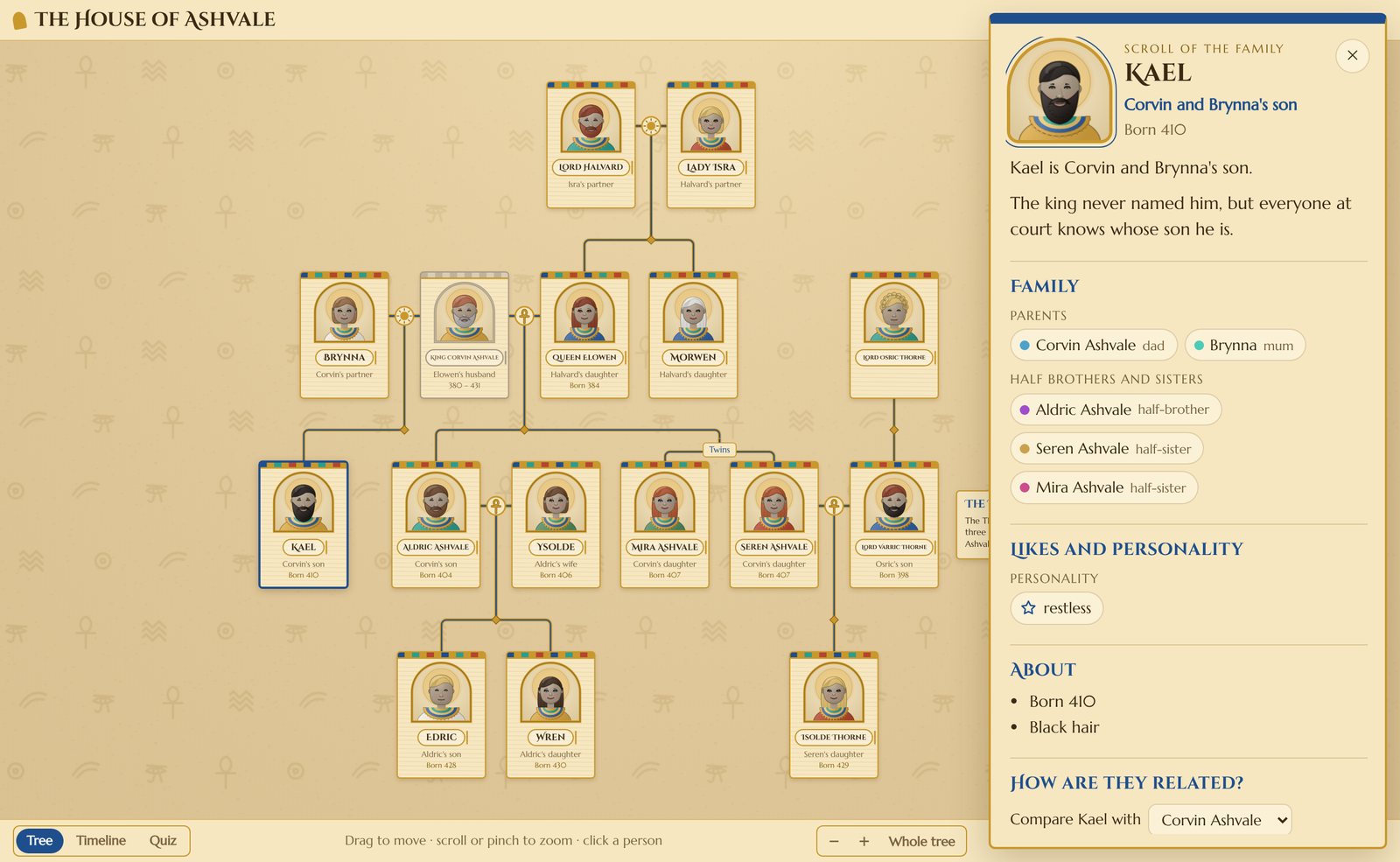
King Corvin and Brynna had a son called Kael.
Kael appears as Corvin's son, and his card lists Aldric, Seren and Mira as his half-brother and half-sisters. - Second marriages: write each marriage with its year, and the tree shows both partners.
- Twins:
Seren and Mira are twins.
- Deaths:
King Corvin was born in 380 and died in 431.
- Other names:
Vera Rostova is also known as Vera Berg
keeps a married name or a title on the same person. - Characters who don't fit yet: anyone you mention but haven't connected sits to one side until you work out where they belong.
3. Give them personalities, looks and backstories
Write Kael is restless
, Morwen has long white hair
or Varric has a black beard
, and each portrait and card follows. Add a note about anyone with About Kael:
, or about a whole house with About the Thorne family:
.
4. Check your timeline
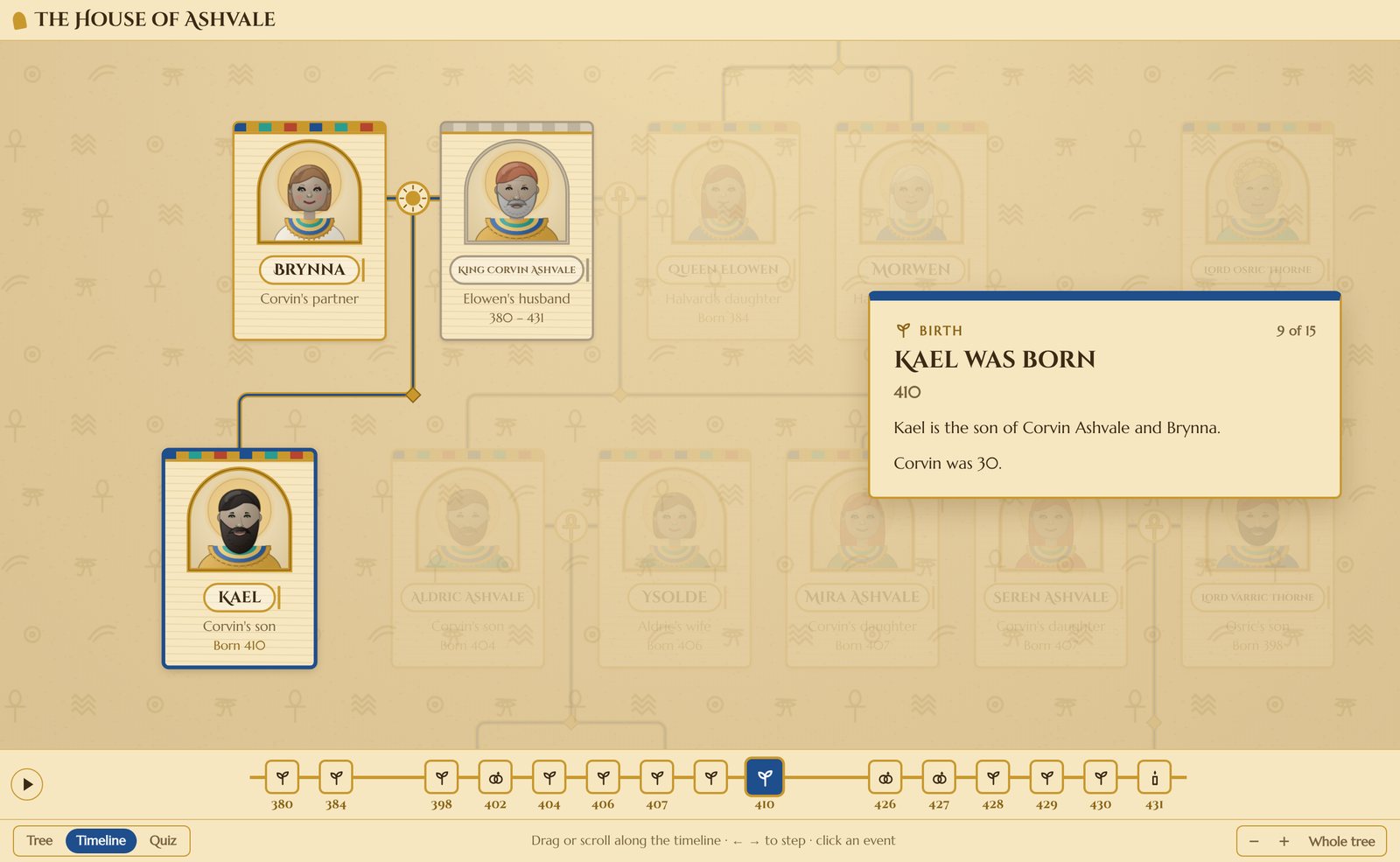
Switch to the Timeline to step through every birth, marriage and death in order. Each event shows who was involved and how old the parents were, which is where continuity mistakes show up.
5. Choose a design that fits your world
The same family can look completely different. Change the design with one click, and nothing in your story changes.
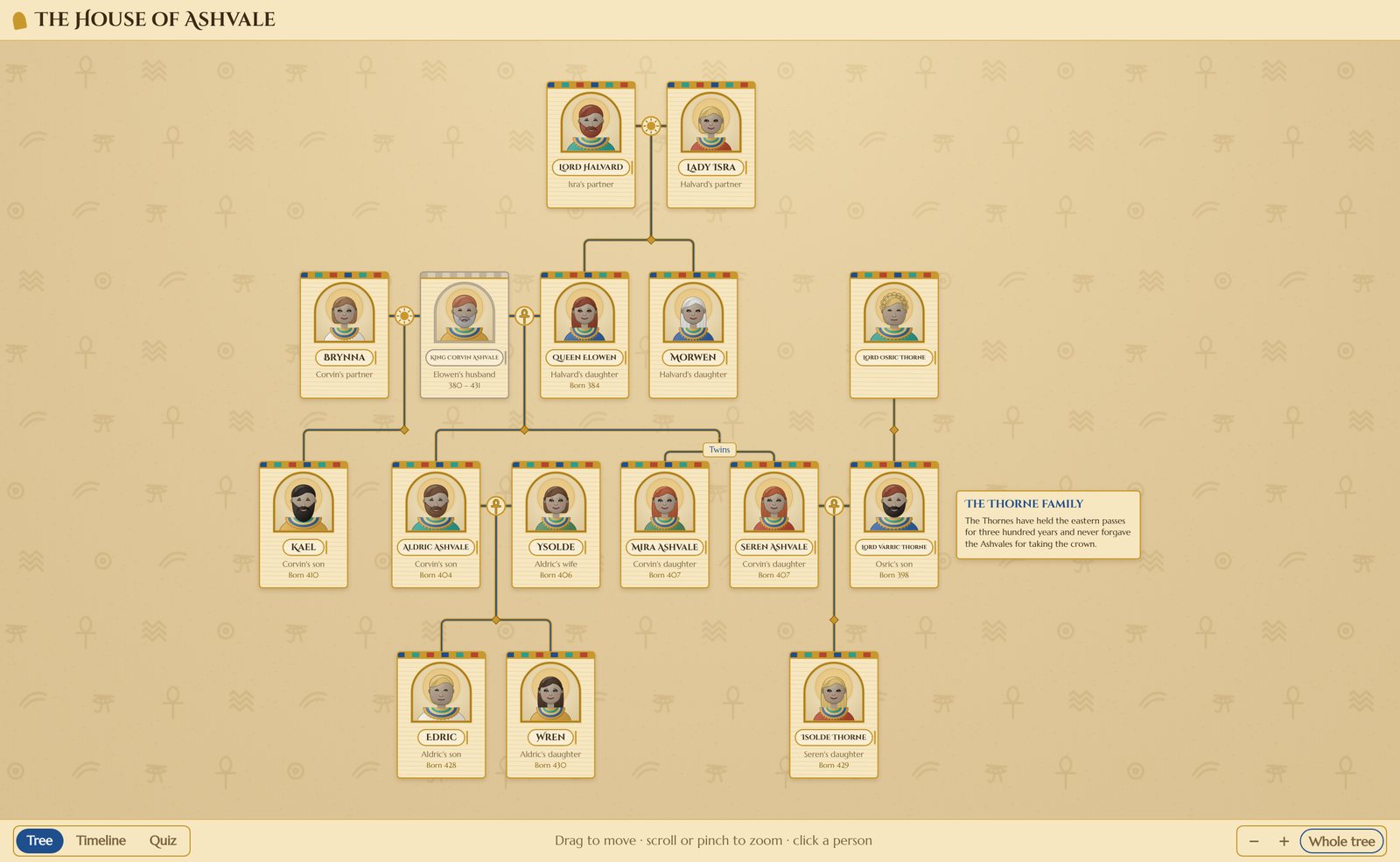
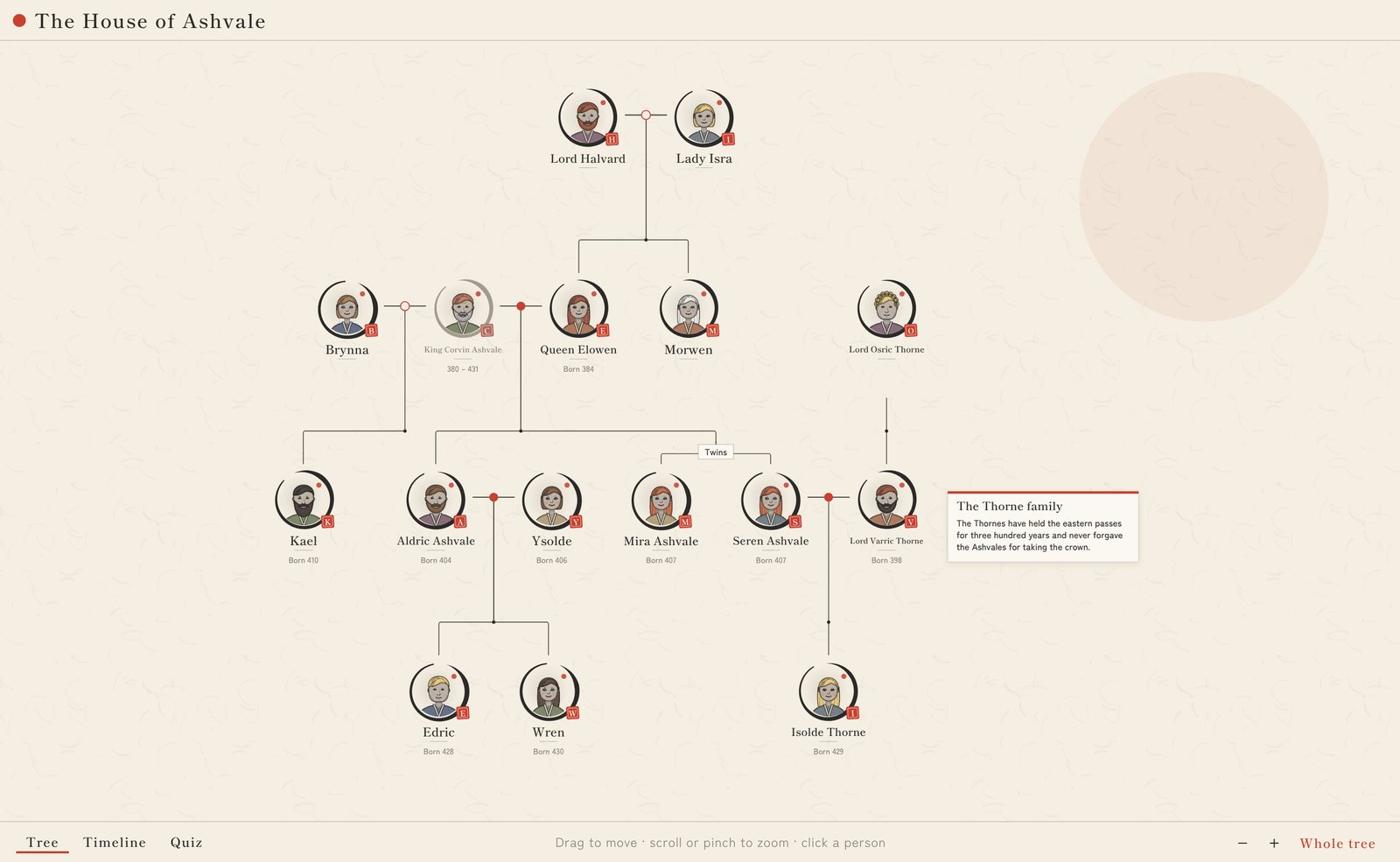
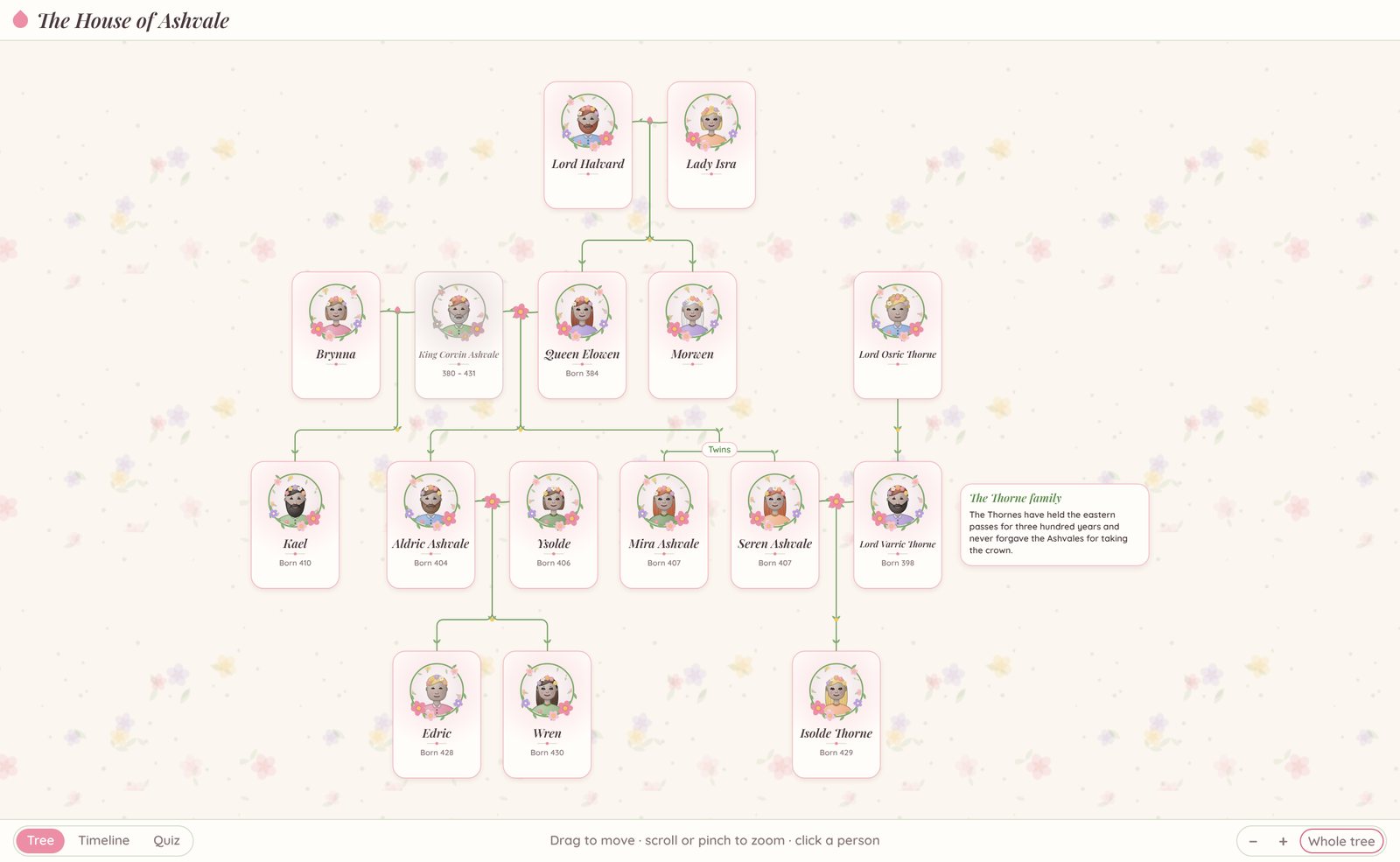
Ancient, Zen, Flowers and Vintage are premium designs. A free account can use designs like Storybook, Royal and Superheroes.
Example: the family tree of War and Peace
Tolstoy's War and Peace follows five noble families, and readers have kept notes to track them since 1869. Here are the Bezukhovs, Rostovs, Bolkonskys and Kuragins in the Vintage design, like old photos in an album.
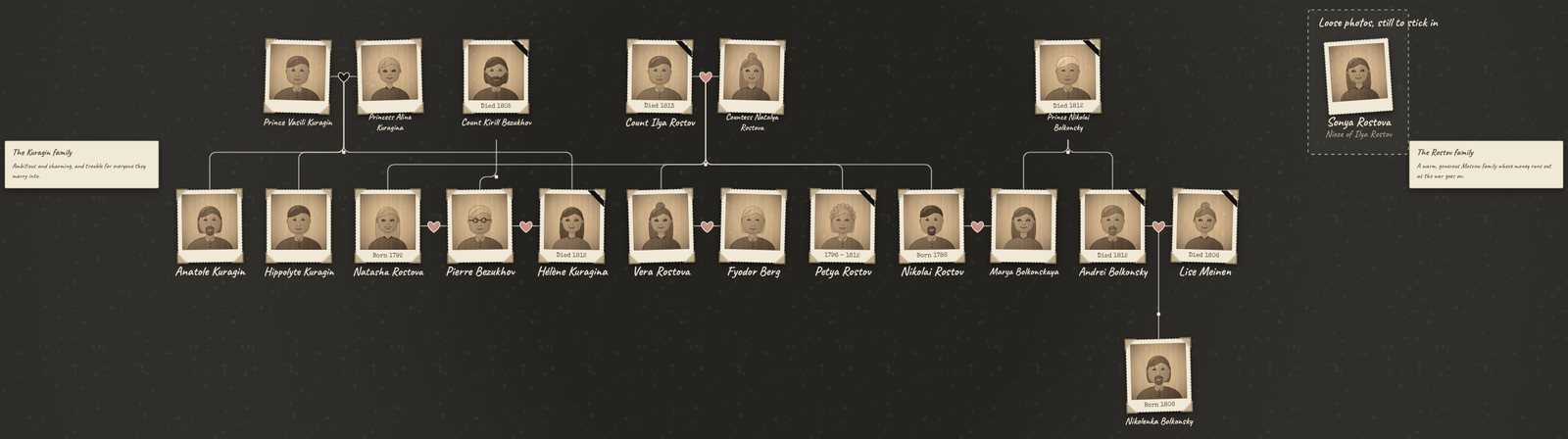
Sonya, the Rostovs' cousin, sits to one side as a "loose photo": the story says she is Count Rostov's niece, but not who her parents are. That's exactly how a draft works. You can leave a character unattached until you know where they belong. War and Peace is also one of the examples in the editor, so you can open it and see the sentences behind it.
Share it with your beta readers
Share your tree with a link, and choose who can see it: anyone with the link, only people who know a secret word, or just you. It's a handy companion for beta readers, a book club or the front of a fan wiki. Premium accounts can also save the tree as a picture for a book's endpapers or a website.
Character family trees: quick answers
Can I make a family tree for fictional characters?
Yes. PeoplePlotr works just as well for invented families as real ones. Names, titles, made-up years and fantasy houses are all fine.
Can I show illegitimate children and half-siblings?
Yes. Say who a character's parents are, married or not, and their card shows their half-brothers and half-sisters.
How many characters can I add?
A free account makes one tree with up to 25 people, enough for a central family like the Ashvales. Premium accounts can make bigger trees for a whole saga.
Can I use it for a real historical family?
Yes. See our Tudor family tree for Henry VIII, his six wives and their children.
Start your character family tree Explore the House of Ashvale full screen