How to make a family tree: a guide for kids and school projects
A family tree shows how everyone in your family is connected: you, your brothers and sisters, your parents, your grandparents and beyond. It's one of the most popular school projects, and one of the most fun. This guide shows you how to make one, step by step, using Maya's family as an example.
What is a family tree?
A family tree is a picture of a family. Each row is a generation: people born around the same time. Your grandparents are usually at the top, your parents in the middle and you and your brothers, sisters and cousins at the bottom. Lines join parents to their children, and a heart or a line joins two people who are married or partners.
It's called a tree because it branches out. Each person has two parents, four grandparents and eight great-grandparents, so the further back you go, the wider it gets.
Step 1: Ask your family
The best family trees start with a chat. Ask a parent, grandparent or older relative to help. Here are some questions to ask:
- What are everyone's names? What did Grandma call herself before she was married?
- When and where was everyone born? A year is fine if nobody knows the exact date.
- Who is married to whom, and who are their children?
- What jobs did people do? What were their hobbies?
- Did anyone have pets?
- Who is in the old photos, and is there a funny story about them?
Write the answers down as you go. Don't worry if there are gaps. You can leave something out, or say "about 1950" when nobody is quite sure.
Step 2: Start with yourself
Begin with the person you know best: you. Then add the people closest to you and work outwards:
- you, and your brothers and sisters
- your parents
- your grandparents
- your aunts, uncles and cousins
- great-grandparents, if you can find out about them
Most school projects ask for three generations: you, your parents and your grandparents. Check what your teacher wants before you go further back.
Step 3: Write it down and watch the tree grow
Drawing a tree by hand can get messy when you run out of room. With PeoplePlotr you write about your family in plain sentences, the way you'd tell a friend, and the tree draws itself as you type. Maya started like this:
My name is Maya. I am 9. My mum is Grace and my dad is Tom. I have a little brother called Leo. My mum's mum is Rose.
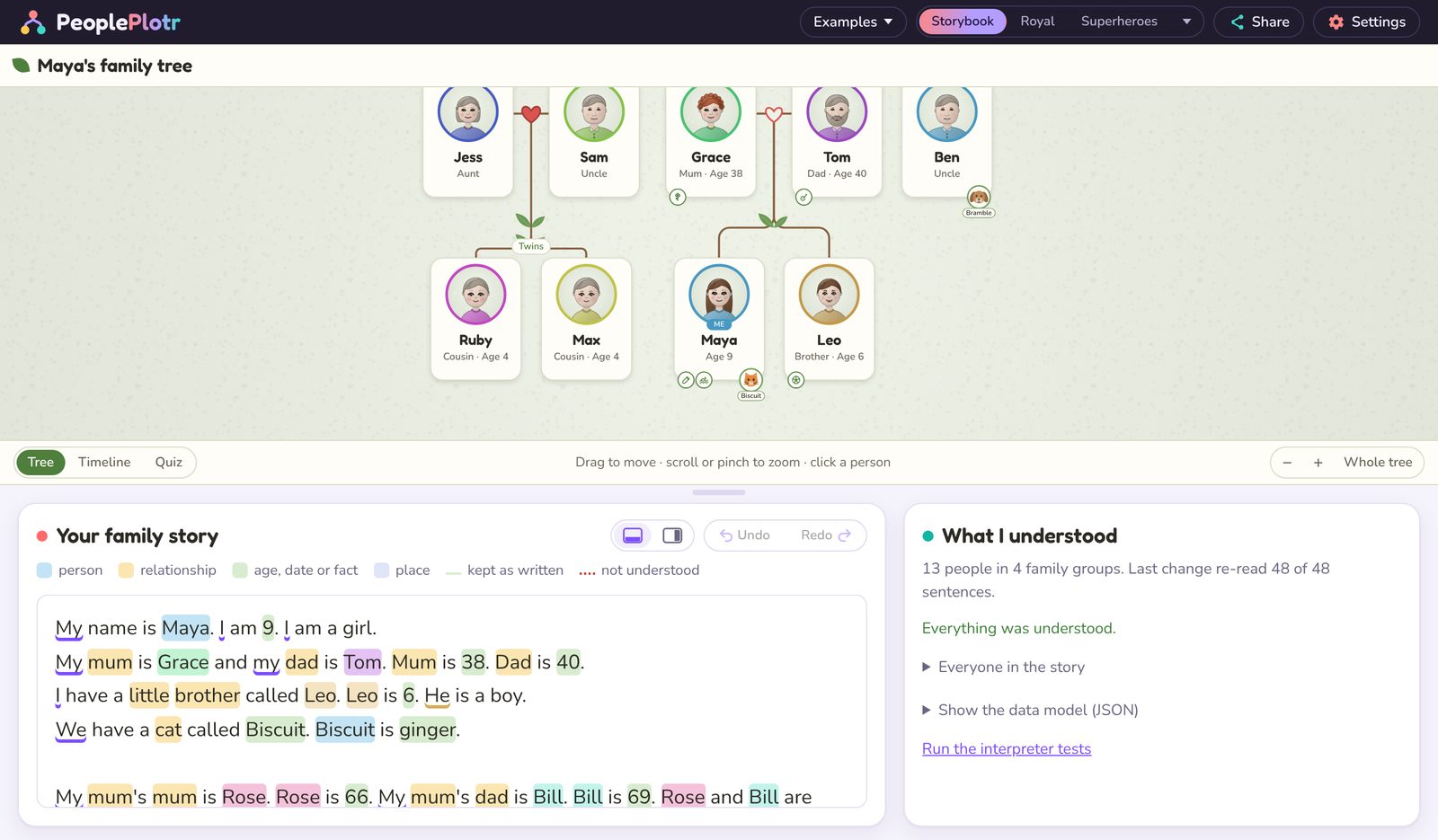
The colours are a good way to check your writing. If a sentence isn't understood, it gets a dotted underline, so you can try saying it another way. Short, clear sentences work best.
Step 4: Add the fun bits
A family tree doesn't have to be just names and dates. Add what people are like, what they love doing and what they look like. Write Dad plays the guitar
, Grandma wears glasses
or We have a cat called Biscuit
, and it all shows on the tree.
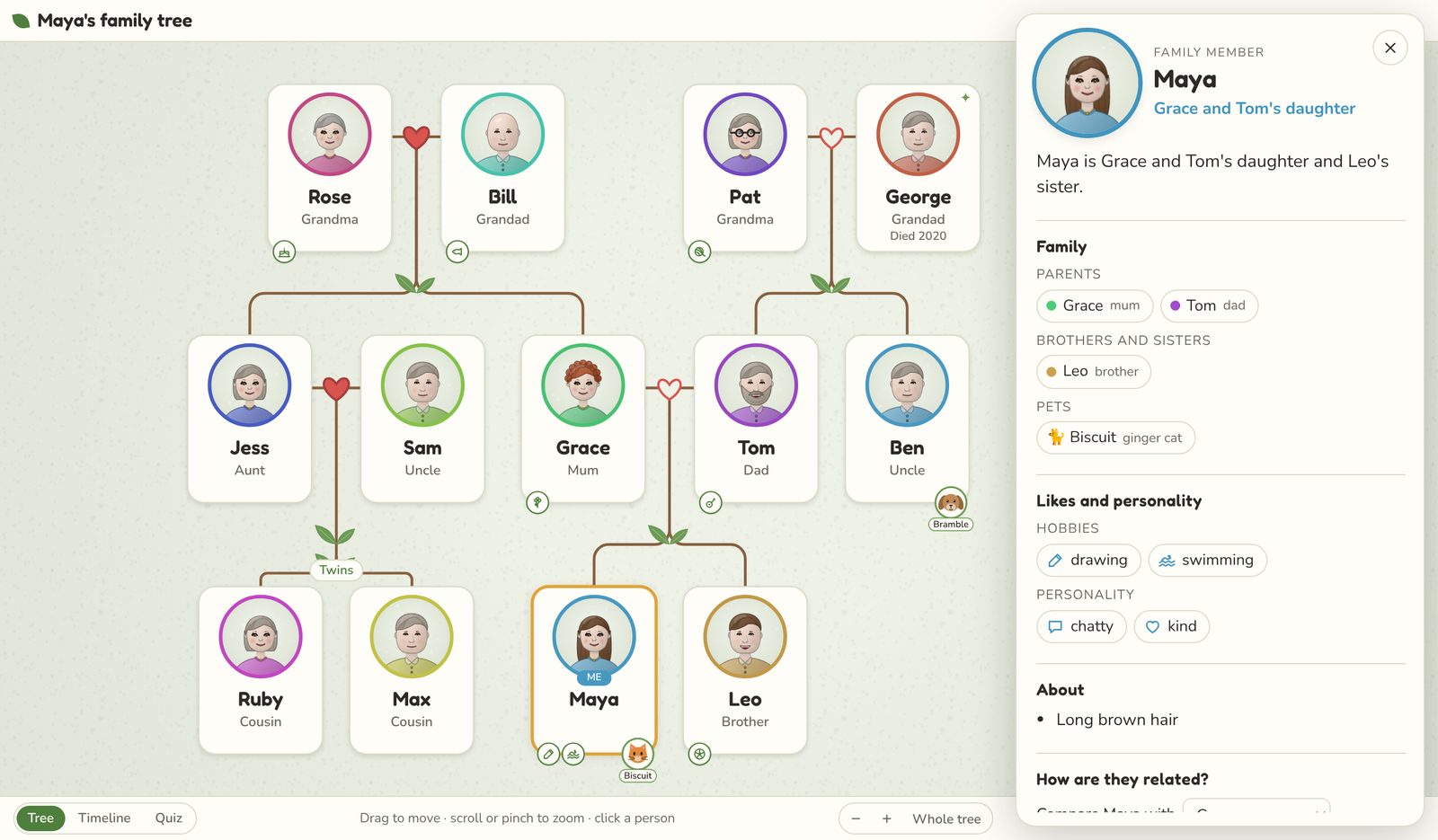
You can also change the whole tree's design with one click, from Storybook to Royal, Superheroes or Space Crew.
Step 5: Check it, play it and share it
When you've finished, test your family with the quiz. It asks questions made from your own tree, like Who has a dog called Bramble?
or Who was born first?
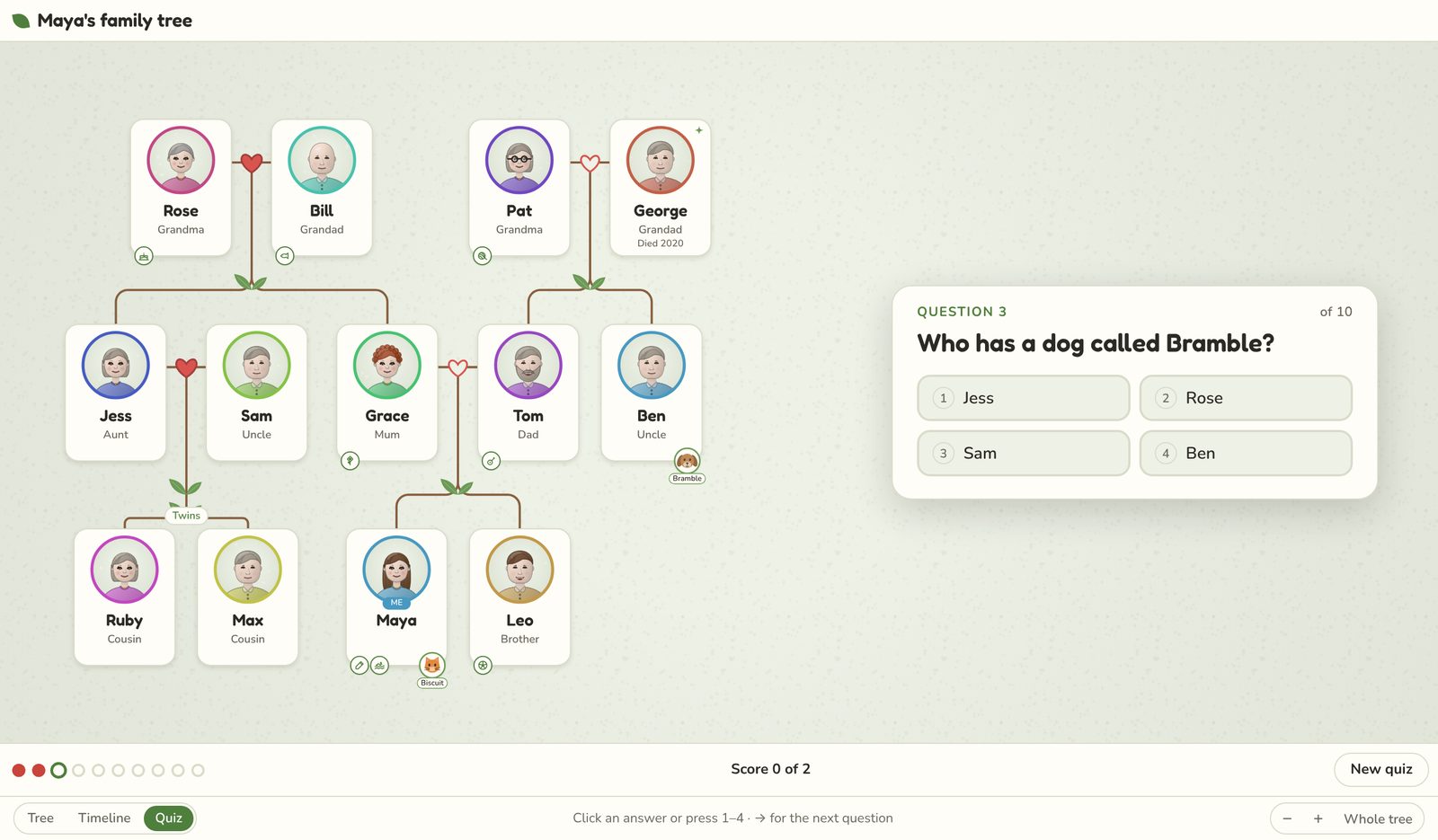
To hand it in, share a link with your teacher. You decide who can see it: anyone with the link, only people who know a secret word, or just you. Ages of living people are left out unless you choose to show them, and you can hide surnames too. Saving the tree as a picture to print needs a premium account.
Family words explained
| Word | What it means |
|---|---|
| Grandparent | Your parent's mum or dad |
| Great-grandparent | Your grandparent's mum or dad |
| Aunt or uncle | Your parent's sister or brother, or their husband or wife |
| Cousin | Your aunt or uncle's child |
| Niece or nephew | Your brother or sister's child |
| Twins | Two children born to the same mum at the same time |
| Stepparent | Your mum or dad's husband, wife or partner, who isn't your birth parent |
| Stepbrother or stepsister | Your stepparent's child |
| Half-brother or half-sister | A brother or sister who shares one of your parents, but not both |
| In-law | Someone you're related to by marriage, like your mum's sister's husband |
Every family is different
Lots of families don't look like the trees in textbooks. Some children have stepparents and stepbrothers or stepsisters, some live with one parent or with grandparents, and some are adopted or fostered. All of these families belong on a family tree, and it's your tree, so you choose who goes on it.
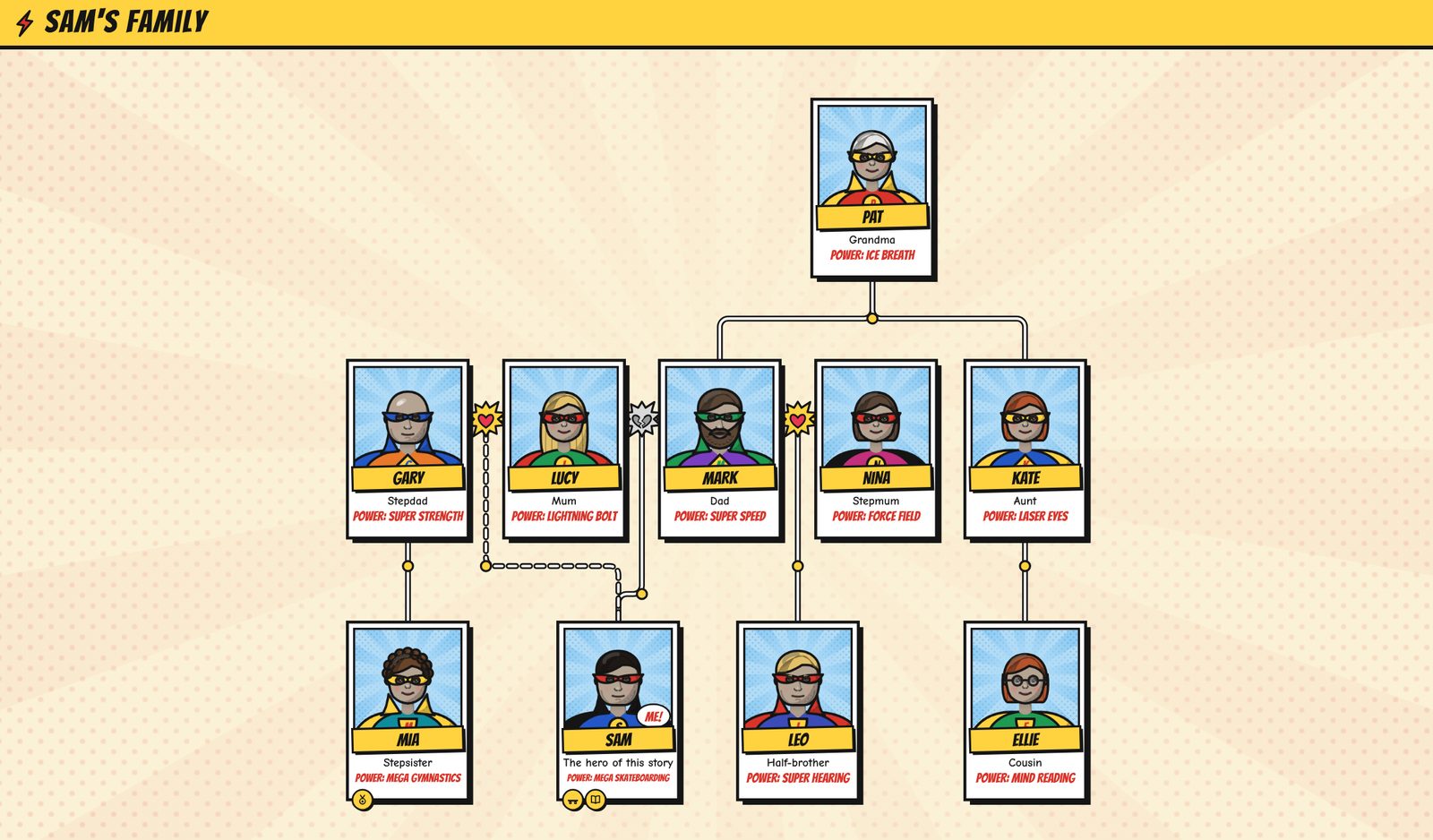
Sam wrote sentences like My parents are divorced
, My stepdad is Gary. He has a daughter called Mia, so she is my stepsister
and Mark and Nina have a son called Leo
, and PeoplePlotr worked out where everyone goes.
If a family history topic is hard for someone, a teacher can let pupils choose whose tree to make: their own family, a friend's, a family from a book or a famous family.
For teachers
Family trees fit into many subjects. In English, the tree only grows from clear, precise sentences, and the colours show pupils straight away what was understood. In history, pupils can build famous families like the Tudor family tree and step through them on the timeline. Education accounts are coming soon, with a Silver account for the teacher and 50 Bronze accounts for pupils.
Children under 13 need a parent's permission to sign up. A parent can make the account and help their child use it. Anyone can try PeoplePlotr on the home page without signing up.
Family tree projects: quick answers
What should a family tree project include?
Usually three generations (you, your parents and your grandparents), with names and birth years. Extra details like jobs, hobbies, pets, where people were born and a family story make it stand out.
What if I don't know someone's details?
Leave them out, or say what you do know, like "Great-grandad was born about 1930". A family tree can always be added to later.
Do I have to include everyone?
No. It's your family tree, and you can choose who goes on it.
Is PeoplePlotr free?
Yes. A free account makes one tree with up to 25 people and shares it with a link. Premium accounts can make bigger trees and save them as pictures.