Family tree with adoption
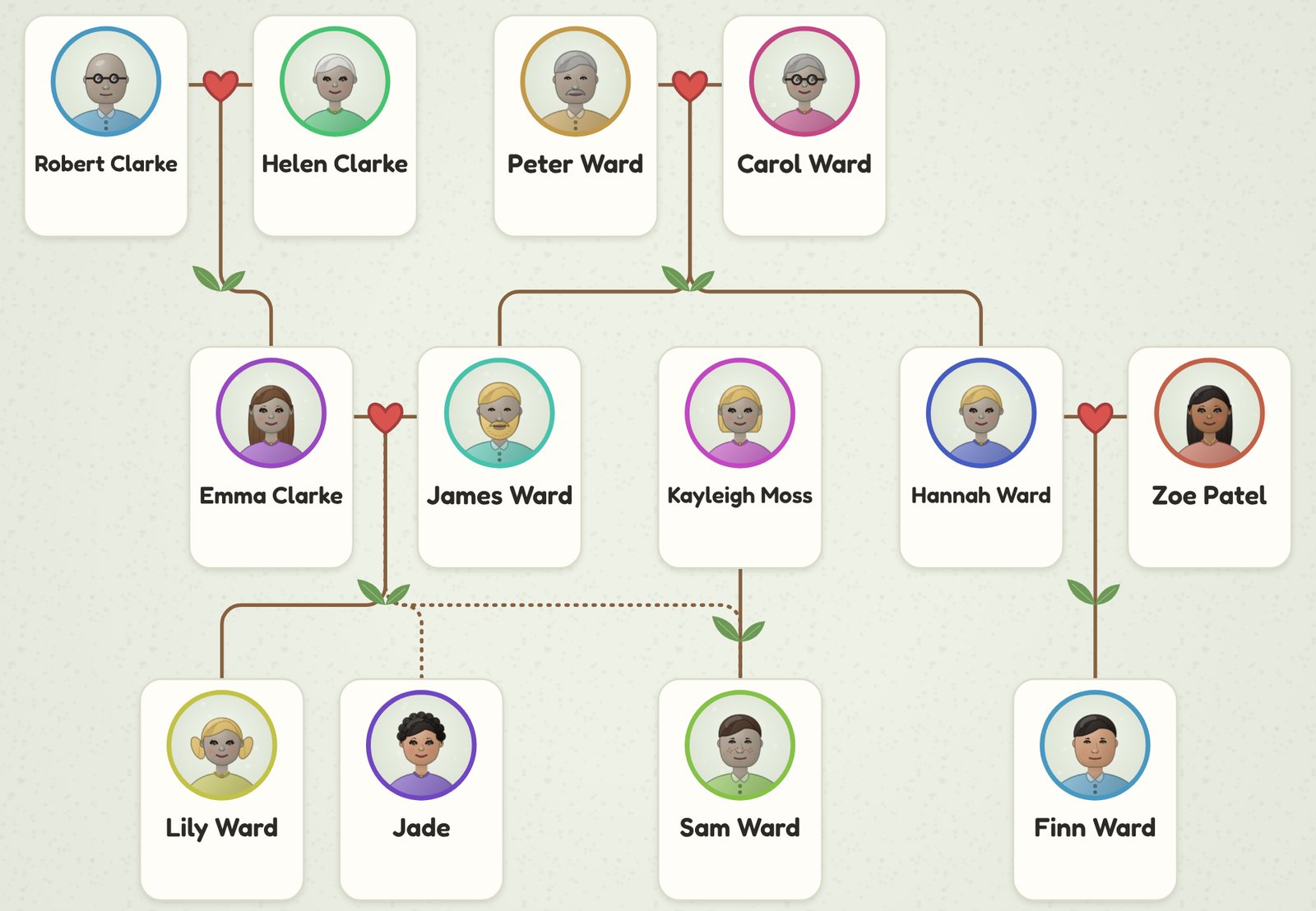
A family tree is supposed to show who belongs to whom. With adoption, fostering and two-mum or two-dad families, a lot of templates fall apart, or worse, quietly leave people out. Here's an example family tree with an adopted son, his birth mother, a foster daughter, a younger sister born to the family, and an aunt and her wife. Below it are the plain sentences that draw it.
Meet the family
Emma and James married in 2010.
- In 2017 they adopted Sam, who was two. His birth mother is Kayleigh.
- Two years later Lily was born.
- They also foster Jade, who has lived with them since she was small.
- James's sister Hannah married Zoe in 2016, and they have a son, Finn.
Grandparents sit on both sides at the top. Robert and Helen are Emma's parents, and Peter and Carol are James and Hannah's.
How it's written
You don't draw lines or pick symbols. You write it down and the tree does the rest. These are the sentences for Emma and James's part of the family:
Emma married James in 2010.
Emma and James adopted a son called Sam Ward in 2017. Sam was born in 2015.
Sam's birth mother is Kayleigh Moss.
Emma and James had a daughter called Lily Ward.
Jade is the foster daughter of Emma and James.
Hannah married Zoe Patel in 2016.
Hannah and Zoe had a son called Finn Ward.
- "Adopted" joins Sam to Emma and James with a dotted line, and his card says when he was adopted.
- "Birth mother" adds Kayleigh with a solid line to Sam. She isn't joined to anyone else, so she sits on her own.
- "Foster daughter" also gives a dotted line, so Jade is part of the family on the tree without being counted as born to it.
- Two mums need nothing special. "Hannah married Zoe" and "Hannah and Zoe had a son" is all it takes. The tree doesn't care whether a couple is a man and a woman.
Should birth family go on the tree?
That's up to your family, and there's no wrong answer. Some families stay in touch with birth relatives and want them on the tree. Others would rather keep the tree to the family the child is growing up in. If you leave out the sentence about Kayleigh, Sam simply appears as Emma and James's son, with the dotted line.
A few things that can help:
- Ask the child, if they're old enough. It's their story first. Older children often have strong views about who should be on it.
- Make two versions if you need to. One tree can include birth family, and the version you share at school or with relatives can leave it out.
- Use it alongside a life story book. Adopted children often have one put together with their social worker. A tree can sit next to it.
- Mind your privacy settings. Birth family details can be sensitive. Living people's full birthdays stay on your own device, and you choose whether to share the tree at all.
Family tree projects at school
The classic school project, "draw your family tree", can be hard for adopted and fostered children and for children with two mums or two dads. If you're a teacher, ask for "the people in your family" rather than "your mum and dad and their parents", and let children choose who goes on. A tree like this one shows that a dotted line is as much a part of the family as a solid one.
Quick answers
How do you show adoption on a family tree?
Join the child to their adoptive parents with a different line from a birth link. A dotted or dashed line is the usual way. In PeoplePlotr you just write "adopted a son called Sam".
Can you show both birth parents and adoptive parents?
Yes. Give the child a birth mother or birth father as well, and the tree shows both links.
How do you show a foster child?
The same way, with "foster daughter" or "foster son", which also gives a dotted line.
How do you show same-sex parents on a family tree?
Exactly as you would any other couple. Write that they married, or that they had a child together.
Is this a real family?
No, we made them up. But families like this one are common.
The story behind this tree
PeoplePlotr drew this tree from a few hundred words of plain English. Nobody dragged a box or drew a line. Here is the story, word for word. Open it in the editor to change it, add to it or use it as the start of your own.
Read the story
Robert Clarke married Helen Clarke in 1978. Robert is a man. Helen is a woman. They had a daughter called Emma Clarke. Emma was born in 1984.
Peter Ward married Carol Ward in 1980. Peter is a man. Carol is a woman. They had two children, James Ward and Hannah Ward. James was born in 1982. Hannah was born in 1986. James is a man. Hannah is a woman.

Emma married James in 2010.
Emma and James adopted a son called Sam Ward in 2017. Sam was born in 2015.
Sam's birth mother is Kayleigh Moss. Kayleigh was born in 1996.
Emma and James had a daughter called Lily Ward. Lily was born in 2019.
Jade is the foster daughter of Emma and James. Jade was born in 2012.

Hannah married Zoe Patel in 2016. Zoe is a woman. Zoe was born in 1987.
Hannah and Zoe had a son called Finn Ward. Finn was born in 2018.

Robert is bald and has glasses. Helen has short white hair. Peter has grey hair and a moustache. Carol has short grey hair and glasses.
Emma has long brown hair. James has short fair hair and a beard. Hannah has short fair hair. Zoe has brown skin and long black hair.
Sam has dark brown hair and freckles. Lily has fair hair in pigtails. Jade has light brown skin and curly black hair. Finn has light brown skin and black hair.
Kayleigh has blonde hair.