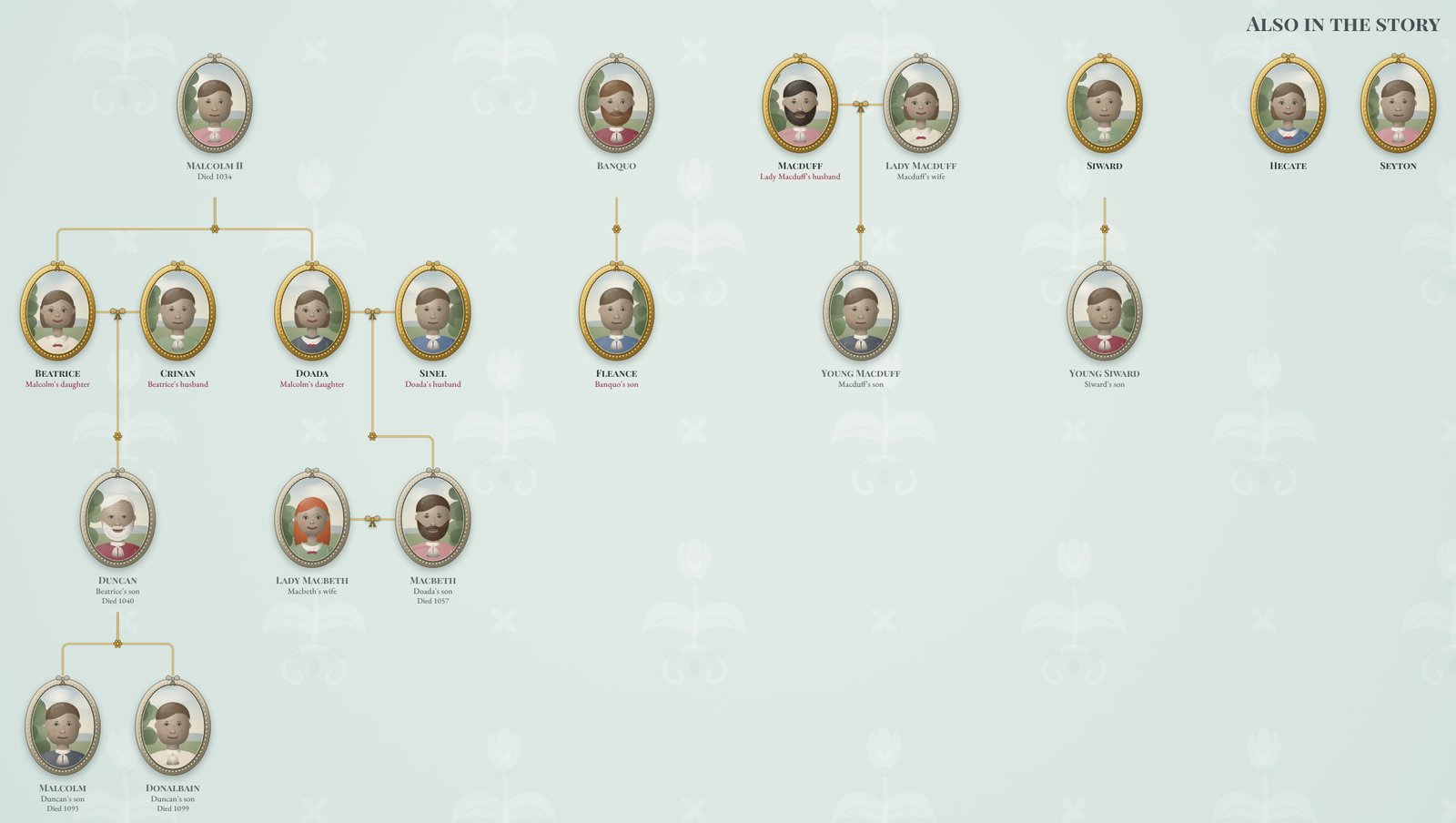
Macbeth family tree
In the first act of Macbeth, King Duncan greets Macbeth as "valiant cousin". It isn't just politeness. In the history book Shakespeare worked from, the two men are first cousins, grandsons of the same king. That makes Macbeth's crime a family murder as well as a political one. Here's the family behind the play, and how it compares with the real kings of Scotland.
Spoiler warning: the tree and the notes on each card show who dies and who ends up king.
Cousins, according to Holinshed
Shakespeare took the story from Raphael Holinshed's Chronicles, a history of England, Scotland and Ireland published in 1577 and again in 1587. Holinshed says that King Malcolm II had two daughters. Beatrice married Crinan, Thane of the Isles, and their son was Duncan. Doada married Sinel, Thane of Glamis, and their son was Macbeth.
Sinel turns up in the play only as a name. When the witches hail Macbeth as Thane of Glamis, he answers, "By Sinel's death I know I am thane of Glamis." It's the one prophecy he already knew was true.
Who's who
Duncan's family
- Duncan, King of Scotland. He's murdered in his sleep while staying with Macbeth at Inverness.
- Malcolm, his elder son, whom he names Prince of Cumberland, which makes him heir to the throne. He escapes to England after the murder.
- Donalbain, the younger son. He escapes to Ireland, and the play forgets about him.
The Macbeths
- Macbeth, Thane of Glamis, made Thane of Cawdor for his bravery in battle, and then king once Duncan is dead.
- Lady Macbeth, his wife. Shakespeare never gives her a first name.
Banquo and Fleance
- Banquo, Thane of Lochaber, Macbeth's fellow general. The witches tell him "Thou shalt get kings, though thou be none", so Macbeth has him killed.
- Fleance, his son, who gets away from the murderers.
The Macduffs
- Macduff, Thane of Fife, the first to suspect Macbeth.
- Lady Macduff and their son, killed on Macbeth's orders while Macduff is in England. Macduff learns that "all my pretty ones" are dead, so there was more than one child.
The Siwards
- Siward, Earl of Northumberland, who leads the English army. The play calls him Malcolm's uncle. In Holinshed he's Duncan's father-in-law.
- Young Siward, his son, killed by Macbeth in his first battle. His father's only question is whether the wounds were on his front.
The three witches aren't related to anyone, and nobody in the play knows where they came from. We've left them off the tree and kept Hecate, their queen, under "Also in the story". Her scenes were probably added later by another playwright, Thomas Middleton. Seyton, the officer who tells Macbeth "The queen, my lord, is dead", is there too.
How many children had Lady Macbeth?
None that we ever see. But in Act 1 she says, "I have given suck, and know how tender 'tis to love the babe that milks me." So she has had a baby, and the play never says what happened to it. Macbeth, meanwhile, has "no children" by Act 4, according to Macduff. In 1933 the critic L. C. Knights wrote a famous essay called "How Many Children Had Lady Macbeth?", mocking scholars who treated characters like real people with real family histories. People have been arguing about it ever since. A family tree is, admittedly, on the side he was mocking.
The real Lady Macbeth was called Gruoch, and she did have a son, Lulach, from her first marriage. Lulach became king after Macbeth died and was killed a few months later.
Banquo's line and King James
Banquo and Fleance were made up long before Shakespeare. They first appear in a Scottish history by Hector Boece in 1527, which made Fleance the ancestor of the Stewart kings. By the time Macbeth was written, probably around 1606, a Stewart was on the English throne. James VI of Scotland had become James I of England in 1603, and Shakespeare's company were now the King's Men.
That explains one of the strangest scenes in the play. In Act 4 the witches show Macbeth a line of eight kings, all descended from Banquo, the last carrying a mirror that shows many more. Audiences in 1606 would have seen the line running all the way to the king who paid Shakespeare's company. It also explains why Banquo, who hears the same prophecy as Macbeth, stays honest. James was not going to sit through a play where his ancestor helped murder a king.
What really happened
The years on the tree are the real ones, but most of the plot isn't.
- Duncan I wasn't an old man murdered in bed. He was probably still in his thirties when he died in 1040, fighting Macbeth's army near Elgin.
- Macbeth was the son of Findláech, ruler of Moray, not of anyone called Sinel. Some later chroniclers said his mother was a daughter of Malcolm II, but nobody really knows.
- He ruled for seventeen years, by medieval standards quite steadily. In 1050 he went on pilgrimage to Rome, where a chronicler says he scattered money to the poor like seed.
- Malcolm killed him in battle at Lumphanan in 1057. It wasn't Macduff, who may not have existed at all. Malcolm then got rid of Lulach and reigned as Malcolm III until 1093.
- Donalbain didn't disappear. As Donald III he was king twice in the 1090s, after his brother.
Quick answers
Are Macbeth and Duncan related?
In Holinshed's Chronicles, Shakespeare's source, yes. They're first cousins, both grandsons of Malcolm II. The play only hints at it, with Duncan calling Macbeth "cousin".
Who becomes king at the end of Macbeth?
Malcolm, Duncan's elder son. He's crowned at Scone in the last lines of the play.
Was Macbeth a real king?
Yes. Macbeth was King of Scots from 1040 to 1057. The real man was quite different from Shakespeare's.
Was Banquo real?
No. Banquo and Fleance were invented by Scottish historians to give the Stewart kings an older, grander ancestry. The real Stewarts came from a Breton family who settled in Scotland in the 1100s.
The story behind this tree
PeoplePlotr drew this tree from a few hundred words of plain English. Nobody dragged a box or drew a line. Here is the story, word for word. Open it in the editor to change it, add to it or use it as the start of your own.
Read the story
Malcolm II is a king. Malcolm II died in 1034.
About Malcolm II: King of Scots. In Holinshed's Chronicles, both Duncan and Macbeth are his grandsons.
Malcolm II had two daughters, Beatrice and Doada.
Beatrice married Crinan. They had a son called Duncan.
Crinan is a man. Crinan is a thane. About Crinan: Thane of the Isles, and Abbot of Dunkeld in real life.
Doada married Sinel. They had a son called Macbeth.
Sinel is a man. Sinel is a thane. About Sinel: Thane of Glamis. When he dies, Macbeth inherits the title.
Duncan is a man. Duncan is a king. Duncan had two sons, Malcolm and Donalbain. Duncan died in 1040.
About Duncan: King of Scotland, murdered in his sleep by Macbeth at Inverness.
Macbeth married Lady Macbeth.
Macbeth is a king. Macbeth died in 1057.
About Macbeth: Thane of Glamis, then Thane of Cawdor, then King of Scotland. Killed in battle by Macduff.
Lady Macbeth died.
About Lady Macbeth: She talks her husband into killing Duncan, then walks in her sleep trying to wash the blood off her hands.
Malcolm is a king. Malcolm died in 1093.
About Malcolm: Prince of Cumberland. He flees to England when his father is killed and comes back with an army.
Donalbain died in 1099.
About Donalbain: He escapes to Ireland after his father's murder.

Banquo had a son called Fleance. Banquo is a man. Banquo is a thane. Banquo died.
About Banquo: Thane of Lochaber. The witches tell him his descendants will be kings, so Macbeth has him murdered.
About Fleance: He escapes the murderers who kill his father.

Macduff married Lady Macduff. Macduff is a man. Macduff is a thane.
About Macduff: Thane of Fife. Born by caesarean, so not "of woman born".
Macduff and Lady Macduff had a son called Young Macduff.
Lady Macduff died. Young Macduff died.
About Lady Macduff: Murdered with her children on Macbeth's orders while her husband is in England.

Siward is a man. Siward is an earl.
About Siward: Earl of Northumberland, who leads the English army against Macbeth.
Siward had a son called Young Siward.
Young Siward died.
About Young Siward: Killed fighting Macbeth in his first battle.

Duncan is old and gracious. Duncan has white hair and a white beard.
Macbeth is brave and ambitious. Macbeth has dark hair and a beard.
Lady Macbeth is ambitious and ruthless. Lady Macbeth has long red hair.
Banquo is loyal. Banquo has brown hair and a beard.
Macduff is brave. Macduff has black hair and a beard.
Malcolm is careful. Fleance is a boy. Young Macduff is a boy. Young Siward is young.
Hecate is a witch. Hecate is a woman.
About Hecate: Queen of the witches. The three Weird Sisters answer to her.
Seyton is a servant. Seyton is a man.
About Seyton: Macbeth's last loyal officer, who brings him the news that the queen is dead.