Brontë family tree
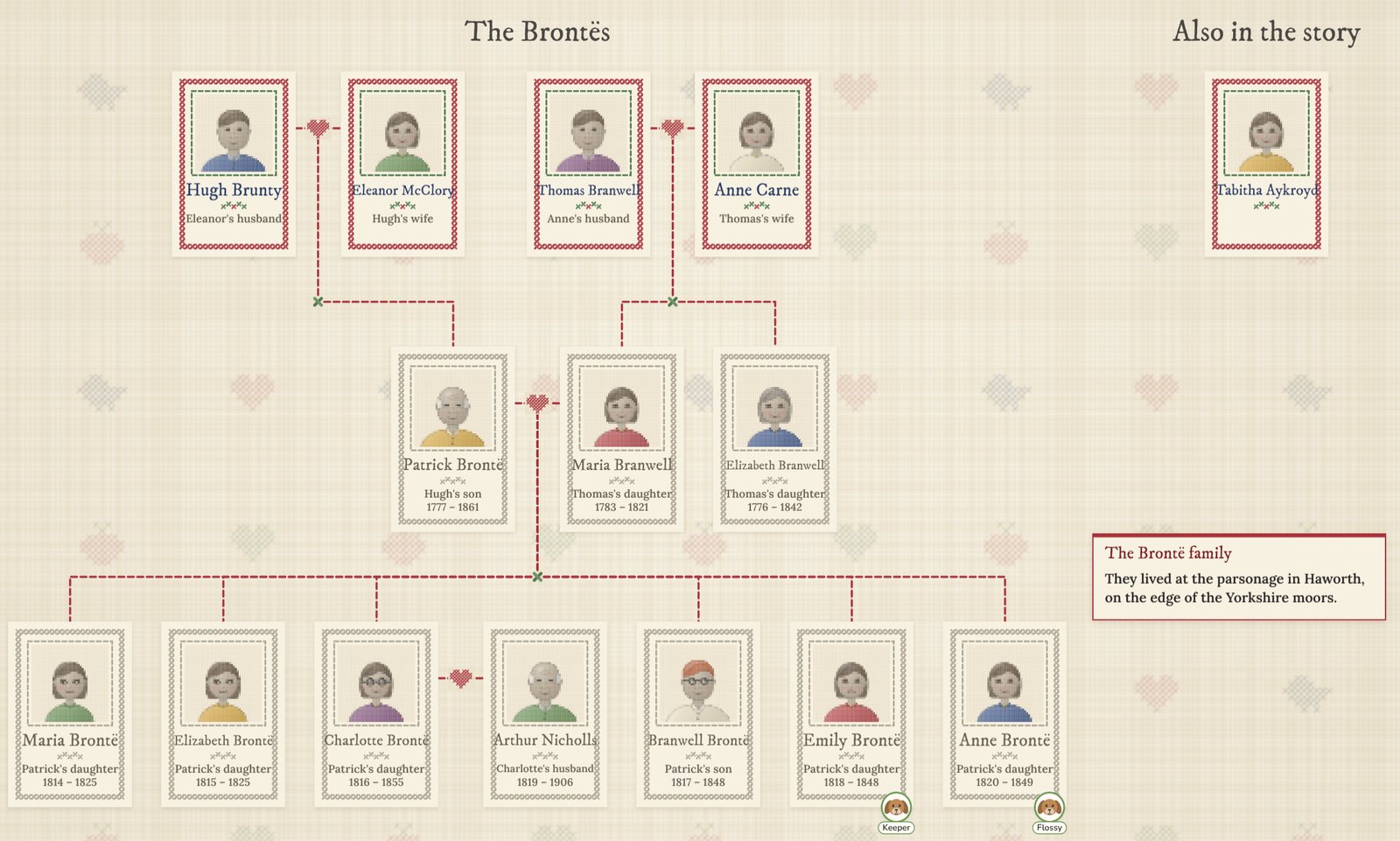
Patrick Brontë buried his wife and all six of his children, and lived on alone in the parsonage at Haworth until he was 84. Three of those children wrote some of the best-loved novels in English, under men's names. Here's the whole family on one page, from a farm in County Down to the edge of the Yorkshire moors.
From Brunty to Brontë
Patrick was born in 1777 in County Down, the eldest of the ten children of Hugh Brunty and Eleanor McClory. The family was poor. Patrick worked as a teacher before a patron helped him get to St John's College, Cambridge, in 1802. Around then Brunty became Brontë. Nobody knows for sure why. The favourite theory is Lord Nelson, who had just been made Duke of Bronté by the King of Naples.
In 1812, now a clergyman in Yorkshire, Patrick met Maria Branwell, a Methodist from Penzance who was visiting her uncle. They married at Guiseley that December, in a double wedding with Maria's cousin.
Six children in six years
Maria was born in 1814 and Elizabeth in 1815. Then came Charlotte, Branwell, Emily and Anne, all four born in the village of Thornton near Bradford. Branwell, the only boy, had his mother's surname as his middle name, and the family always used it.
In April 1820 the family moved to Haworth, where Patrick was the parson for the rest of his life. Seventeen months later his wife was dead, probably of cancer, at 38. Her elder sister Elizabeth Branwell came up from Cornwall to help with the children. She stayed for over twenty years, and the children called her Aunt Branwell.
Cowan Bridge
In 1824 the four eldest girls went to the Clergy Daughters' School at Cowan Bridge. It was cold and the food was poor. Maria and Elizabeth caught tuberculosis there and were sent home to die. Maria was 11 and Elizabeth 10, and they died six weeks apart in 1825. Patrick fetched Charlotte and Emily home. Charlotte never forgave the school. Twenty years later it became Lowood in Jane Eyre, and Maria became the saintly Helen Burns.
Twelve toy soldiers
In 1826 Patrick brought Branwell home a box of wooden soldiers. Each child grabbed one and named it, and the four of them spent years afterwards writing about the soldiers' made-up world. Charlotte and Branwell wrote about Glass Town, which later became Angria. Emily and Anne broke away and invented Gondal. They wrote in tiny books, some about the size of a matchbox, in handwriting so small that adults couldn't easily read it. That was probably the point.
Currer, Ellis and Acton Bell
In 1846 the three sisters paid to publish a book of their poems as Currer, Ellis and Acton Bell. Each kept her own initials, and the names didn't give away that they were women. It sold two copies. A year later all three had novels out. Jane Eyre came out in October 1847 and was a hit straight away. Wuthering Heights and Agnes Grey followed in December. Their publishers, and the critics, weren't sure if the Bells were one writer or three. In 1848 Charlotte and Anne went to London to show Charlotte's publisher that there really were two of them.
Eight months
Branwell was supposed to be the genius of the family. He painted and wrote poetry, but every job he tried went wrong. He was dismissed from a post as a tutor in 1845, apparently over an affair with his employer's wife, and fell back on drink and laudanum. He died in September 1848, aged 31.
Emily caught a cold at his funeral. She refused to see a doctor until her last day and died that December, aged 30. Anne was already ill. She went to Scarborough in May 1849, hoping the sea air would help, and died there a few days after arriving, aged 29. She's the only one of the family not buried at Haworth. Three children died in eight months, and Charlotte was the only one left.
Charlotte, the last
In 1854 Charlotte married Arthur Bell Nicholls, her father's curate. Patrick was furious when Arthur first proposed, but came round. The marriage was happier than anyone expected and lasted nine months. Charlotte died in March 1855, a few weeks short of her 39th birthday, while expecting her first child. Her death certificate says tuberculosis, but many people now think it was severe sickness in pregnancy.
Arthur stayed on at the parsonage and looked after Patrick until he died in 1861. Then he went home to Ireland, married his cousin, and kept the family's papers and portraits until he died in 1906. So there are no Brontë grandchildren. The family ended with Charlotte.
The portrait with a ghost in it
About 1834 Branwell painted himself and his three sisters together. Then he painted himself out and put a pillar in his place. The picture spent years folded up on top of a wardrobe in Arthur Nicholls's house in Ireland, and his second wife found it in 1914. It now hangs in the National Portrait Gallery. As the paint has aged, Branwell's face has slowly come back through the pillar.
Key dates
| Year | What happened |
|---|---|
| 1812 | Patrick Brontë marries Maria Branwell |
| 1814–20 | Six children are born: Maria, Elizabeth, Charlotte, Branwell, Emily and Anne |
| 1820 | The family moves to Haworth |
| 1821 | Maria Branwell dies. Her sister Elizabeth comes to help |
| 1825 | Maria and Elizabeth die after coming home from Cowan Bridge |
| 1846 | Poems by Currer, Ellis and Acton Bell |
| 1847 | Jane Eyre, Wuthering Heights and Agnes Grey |
| 1848 | Anne's The Tenant of Wildfell Hall. Branwell dies in September and Emily in December |
| 1849 | Anne dies in Scarborough |
| 1854 | Charlotte marries Arthur Bell Nicholls |
| 1855 | Charlotte dies |
| 1861 | Patrick dies, aged 84 |
Quick answers
How many Brontë sisters were there?
Five: Maria, Elizabeth, Charlotte, Emily and Anne. The two eldest died as children, so the "Brontë sisters" people mean are the three writers, Charlotte, Emily and Anne. They also had a brother, Branwell.
Did any of the Brontës have children?
No. Charlotte was the only one who married, and she died while pregnant. There are no direct descendants. Patrick's brothers and sisters in Ireland had families, so there are distant relatives.
Who was the oldest Brontë?
Maria, born in 1814. Charlotte was the oldest to survive childhood, and the longest-lived of the six, at 38.
Who was Aunt Branwell?
Elizabeth Branwell, their mother's elder sister. She came from Penzance after her sister died in 1821 and brought the children up. When she died in 1842 she left each of her nieces some money, which helped pay for Poems.
Whose dogs were Keeper and Flossy?
Keeper was Emily's big, fierce dog, and Flossy was Anne's spaniel. Elizabeth Gaskell, Charlotte's friend and first biographer, wrote that Keeper walked with the mourners at Emily's funeral.
The story behind this tree
PeoplePlotr drew this tree from a few hundred words of plain English. Nobody dragged a box or drew a line. Here is the story, word for word. Open it in the editor to change it, add to it or use it as the start of your own.
Read the story
Hugh Brunty married Eleanor McClory. Hugh is a man. Eleanor is a woman. They had a son called Patrick Brontë.
Patrick Brontë was born on 17 March 1777 in County Down. Patrick was born Patrick Brunty. Patrick is a clergyman. Patrick died on 7 June 1861 in Haworth.
Thomas Branwell married Anne Carne. Thomas is a man. Anne Carne is a woman. They had two daughters, Maria Branwell and Elizabeth Branwell.
Maria Branwell was born on 15 April 1783 in Penzance. Elizabeth Branwell was born in 1776 in Penzance.

Patrick married Maria Branwell on 29 December 1812 in Guiseley.
They had six children, Maria Brontë, Elizabeth Brontë, Charlotte Brontë, Branwell Brontë, Emily Brontë and Anne Brontë.
Maria Brontë was born in 1814. Elizabeth Brontë was born on 8 February 1815.
Charlotte was born on 21 April 1816 in Thornton. Branwell was born on 26 June 1817 in Thornton. Emily was born on 30 July 1818 in Thornton. Anne was born on 17 January 1820 in Thornton.
Maria Brontë is a girl. Elizabeth Brontë is a girl. Charlotte is a woman. Emily is a woman. Anne is a woman. Branwell is a man.
Maria Branwell died on 15 September 1821 in Haworth.
Maria Brontë died on 6 May 1825 in Haworth. Elizabeth Brontë died on 15 June 1825 in Haworth.
Elizabeth Branwell died on 29 October 1842 in Haworth.
Branwell died on 24 September 1848 in Haworth. Emily died on 19 December 1848 in Haworth. Anne died on 28 May 1849 in Scarborough.
Charlotte married Arthur Nicholls on 29 June 1854 in Haworth. Arthur Nicholls is a curate. Arthur is a man. Arthur was born in 1819 in Ireland.
Charlotte died on 31 March 1855 in Haworth.
Arthur Nicholls died on 2 December 1906.

Charlotte is a writer. Emily is a writer. Anne is a writer. Branwell is a painter.
Charlotte is also known as Currer Bell. Emily is also known as Ellis Bell. Anne is also known as Acton Bell.
Charlotte is small and short-sighted. Charlotte wears glasses. Emily is tall and shy. Anne is gentle. Branwell has red hair. Branwell wears glasses.
Emily has a dog called Keeper. Anne has a dog called Flossy.
About the Brontë family: They lived at the parsonage in Haworth, on the edge of the Yorkshire moors.

Tabitha Aykroyd is a servant at the parsonage. Tabitha is also known as Tabby. Tabitha is a woman.