Wars of the Roses family tree
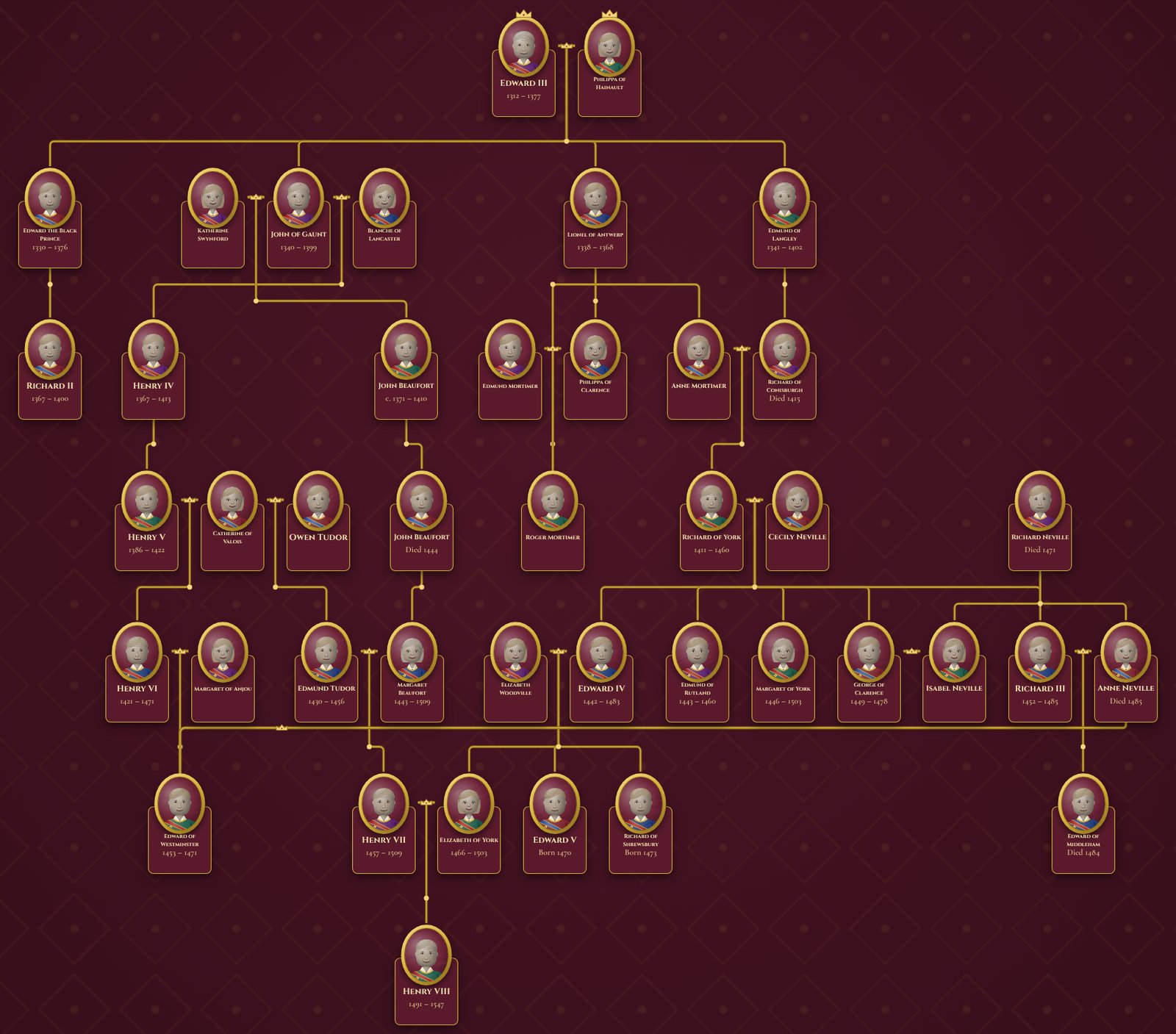
The Wars of the Roses were one family's quarrel. Every king and would-be king in them descended from Edward III, who had too many sons for one crown. The fighting lasted thirty years, from St Albans in 1455 to Bosworth in 1485, and the side you were on mostly came down to which of those sons you descended from, and how. Here's the family tree that explains the whole war.
Edward III's sons
Edward III (died 1377) had five sons who grew up. Four of them matter here:
- Edward the Black Prince, the eldest, died a year before his father. The crown went to his ten-year-old son, Richard II.
- Lionel of Antwerp, the second, had only a daughter, Philippa. Her line passed through the Mortimers to Anne Mortimer.
- John of Gaunt, the third, was Duke of Lancaster. His son became Henry IV, and the Lancastrian kings came from him.
- Edmund of Langley, the fourth, was Duke of York. His son married Anne Mortimer, which is where the Yorkists come from.
That's the whole argument in miniature. The House of Lancaster descended from the third son, through men all the way. The House of York descended from the fourth son through men, but also from the second son through a woman. If a claim through a woman counted, York came first.
How Lancaster got the crown
In 1399 Henry, John of Gaunt's son, came back from exile, deposed his cousin Richard II and made himself Henry IV. Richard died in prison months later. Henry's son Henry V won Agincourt, married the French king's daughter, Catherine of Valois, and died young in 1422. That left the crown to a nine-month-old, Henry VI.
Henry VI grew into a gentle, pious man who had long breakdowns, during which he couldn't speak or recognise anyone. With the king unable to rule, the great lords fought over who should rule for him. Richard, Duke of York, with his double claim, was the obvious candidate. Henry's queen, Margaret of Anjou, was determined that he would not get the job.
York wins, loses and wins again
Richard of York was killed at Wakefield in 1460, along with his son Edmund. His eldest son made himself Edward IV in 1461 and crushed the Lancastrians at Towton, probably the bloodiest battle ever fought in England. Then Edward married Elizabeth Woodville, a widow with a large family to promote. That angered his chief ally, Richard Neville, Earl of Warwick, the "Kingmaker". Warwick switched sides, married one daughter to Edward's brother George and the other to Henry VI's son, and put Henry back on the throne in 1470. Edward came back in 1471 and killed Warwick at Barnet and Henry's son at Tewkesbury. Henry VI died in the Tower soon afterwards.
Look at Anne Neville on the tree. She was married to the Lancastrian heir, and after he was killed she married Edward's youngest brother, Richard. She was the wife of both sides' princes within two years.
The Princes in the Tower
Edward IV died suddenly in 1483. His twelve-year-old son became Edward V, with his uncle Richard as Protector. Within three months Richard had the boys declared illegitimate and took the crown as Richard III. Edward V and his brother Richard of Shrewsbury were lodged in the Tower of London and never seen again. That's why their cards on the tree have no death date. Most historians think Richard had them killed, but it has never been proved, and the argument is still going.
The Tudor outsider
By 1485 so many Lancastrians were dead that the best claim left belonged to Henry Tudor, and it was a thin one. His mother, Margaret Beaufort, descended from John of Gaunt's children with Katherine Swynford. They were born before their parents married. Parliament made them legitimate in 1397, but a later king, Henry IV, added that they couldn't inherit the crown. His father, Edmund Tudor, was the son of a Welsh courtier, Owen Tudor, who had secretly married Henry V's widow. That made Henry VI his half-uncle, but only through his grandmother Catherine's second marriage, which gave him no claim to the English crown.
Henry won at Bosworth anyway. Richard III became the last English king to die in battle, and in 2012 his skeleton turned up under a car park in Leicester. Henry then married Elizabeth of York, Edward IV's eldest daughter, and joined the red rose and the white into the Tudor rose. Their son was Henry VIII. Our Tudor family tree carries on from there.
The kings in order
| King | House | Reigned |
|---|---|---|
| Richard II | Plantagenet | 1377–1399 |
| Henry IV | Lancaster | 1399–1413 |
| Henry V | Lancaster | 1413–1422 |
| Henry VI | Lancaster | 1422–1461 and 1470–1471 |
| Edward IV | York | 1461–1470 and 1471–1483 |
| Edward V | York | 1483 |
| Richard III | York | 1483–1485 |
| Henry VII | Tudor | 1485–1509 |
Quick answers
Why is it called the Wars of the Roses?
After the badges: a red rose for Lancaster and a white rose for York. Nobody at the time called it that. The name caught on in the 19th century, helped along by Sir Walter Scott, and the red rose was mostly a Tudor idea.
Were the Lancastrians and Yorkists related?
Very closely. Both were descended from Edward III, and they married each other repeatedly. Richard III and Anne Neville were cousins, and Henry VI and Edward IV were third cousins.
Who won the Wars of the Roses?
The Tudors, in a way. Henry VII came from the Lancastrian side but married the Yorkist heiress, so his children carried both claims.
What happened to the Princes in the Tower?
No one knows for certain. In 1674 workmen found the bones of two children in the Tower, and they were buried in Westminster Abbey as the princes. The bones were examined in 1933 but have never been DNA tested.
The story behind this tree
PeoplePlotr drew this tree from a few hundred words of plain English. Nobody dragged a box or drew a line. Here is the story, word for word. Open it in the editor to change it, add to it or use it as the start of your own.
Read the story
Edward III married Philippa of Hainault. Edward III is a king. Edward III died in 1377. Edward III was born in 1312.
They had four sons, Edward the Black Prince, Lionel of Antwerp, John of Gaunt and Edmund of Langley.
Edward the Black Prince was born in 1330. Edward the Black Prince died in 1376. Edward the Black Prince had a son called Richard II.
Richard II was born in 1367. Richard II is a king. Richard II died in 1400.
Lionel of Antwerp was born in 1338. Lionel of Antwerp died in 1368. Lionel of Antwerp had a daughter called Philippa of Clarence.
Philippa of Clarence married Edmund Mortimer. They had a son called Roger Mortimer.
Roger Mortimer had a daughter called Anne Mortimer.

John of Gaunt was born in 1340. John of Gaunt died in 1399.
John of Gaunt married Blanche of Lancaster. They had a son called Henry IV.
Henry IV was born in 1367. Henry IV is a king. Henry IV died in 1413. Henry IV had a son called Henry V.
Henry V was born in 1386. Henry V is a king. Henry V died in 1422.
Henry V married Catherine of Valois in 1420. They had a son called Henry VI.
Henry VI was born in 1421. Henry VI is a king. Henry VI died in 1471.
Henry VI married Margaret of Anjou in 1445. They had a son called Edward of Westminster. Edward of Westminster was born in 1453. Edward of Westminster died in 1471.
Catherine of Valois married Owen Tudor. They had a son called Edmund Tudor. Edmund Tudor was born in 1430. Edmund Tudor died in 1456.
John of Gaunt married Katherine Swynford in 1396. They had a son called John Beaufort.
John Beaufort was born about 1371. John Beaufort died in 1410. About John Beaufort: Earl of Somerset. Born before his parents married, and made legitimate in 1397.
John Beaufort had a son called John Beaufort, Duke of Somerset.
John Beaufort, Duke of Somerset died in 1444. John Beaufort, Duke of Somerset had a daughter called Margaret Beaufort.

Edmund of Langley was born in 1341. Edmund of Langley died in 1402. Edmund of Langley had a son called Richard of Conisburgh.
Richard of Conisburgh married Anne Mortimer. They had a son called Richard of York. Richard of Conisburgh died in 1415.
Richard of York was born in 1411. Richard of York died in 1460.
Richard of York married Cecily Neville. They had five children, Edward IV, Edmund of Rutland, Margaret of York, George of Clarence and Richard III.
Edward IV was born in 1442. Edward IV is a king. Edward IV died in 1483. Edmund of Rutland was born in 1443. Edmund of Rutland died in 1460. Margaret of York was born in 1446. Margaret of York died in 1503. George of Clarence was born in 1449. George of Clarence died in 1478. Richard III was born in 1452. Richard III is a king. Richard III died in 1485.
Edward IV married Elizabeth Woodville in 1464. They had three children, Elizabeth of York, Edward V and Richard of Shrewsbury.
Elizabeth of York was born in 1466. Elizabeth of York died in 1503. Edward V was born in 1470. Edward V is a king. Richard of Shrewsbury was born in 1473.
Richard Neville had two daughters, Isabel Neville and Anne Neville. Richard Neville died in 1471.
George of Clarence married Isabel Neville in 1469.
Anne Neville married Edward of Westminster in 1470.
Anne Neville married Richard III in 1472. They had a son called Edward of Middleham. Edward of Middleham died in 1484. Anne Neville died in 1485.

Margaret Beaufort married Edmund Tudor in 1455. They had a son called Henry VII. Margaret Beaufort was born in 1443. Margaret Beaufort died in 1509.
Henry VII was born in 1457. Henry VII is a king. Henry VII died in 1509.
Henry VII married Elizabeth of York in 1486. They had a son called Henry VIII. Henry VIII was born in 1491. Henry VIII died in 1547. Henry VIII is a man.

Edward III is a man. Philippa of Hainault is a woman. Edmund Mortimer is a man. Blanche of Lancaster is a woman. Catherine of Valois is a woman. Margaret of Anjou is a woman. Owen Tudor is a man. Katherine Swynford is a woman. Cecily Neville is a woman.
Edward IV is a man. Edmund of Rutland is a man. Margaret of York is a woman. George of Clarence is a man. Richard III is a man. Elizabeth Woodville is a woman. Elizabeth of York is a woman. Edward V is a man. Richard of Shrewsbury is a man. Richard Neville is a man. Margaret Beaufort is a woman.

About Edward the Black Prince: Edward III's eldest son. He died a year before his father, so the crown skipped to his young son.
About Richard II: Deposed by his cousin Henry IV in 1399, and died in prison.
About Henry IV: The first Lancastrian king. He took the throne from Richard II.
About Henry VI: Became king at nine months old. His bouts of mental illness helped start the wars.
About Margaret of Anjou: Led the Lancastrian side while her husband could not.
About Edward of Westminster: Henry VI's only son, killed at the Battle of Tewkesbury.
About Richard of York: His claim came through his mother, Anne Mortimer, from Edward III's second surviving son, Lionel. Killed at the Battle of Wakefield.
About Edward IV: The first Yorkist king. He won the throne in 1461, lost it in 1470 and won it back in 1471.
About George of Clarence: Changed sides more than once. Executed in the Tower of London, by tradition drowned in a barrel of malmsey wine.
About Richard III: Took the throne from his nephew Edward V. Killed at the Battle of Bosworth.
About Edward V: King for less than three months in 1483. One of the Princes in the Tower.
About Richard of Shrewsbury: The younger of the Princes in the Tower. What happened to them is still argued about.
About Richard Neville: Earl of Warwick, known as the Kingmaker. Killed at the Battle of Barnet.
About Anne Neville: Married first to the Lancastrian heir, then to the Yorkist Richard III.
About Margaret Beaufort: Gave birth to Henry VII at thirteen, and spent the next 28 years working to make him king.
About Henry VII: Won the crown at Bosworth and married Elizabeth of York, joining Lancaster and York.
About Owen Tudor: A Welsh courtier who secretly married Henry V's widow. Executed after the Battle of Mortimer's Cross.
About Henry VIII: See our Tudor family tree for what happened next.